
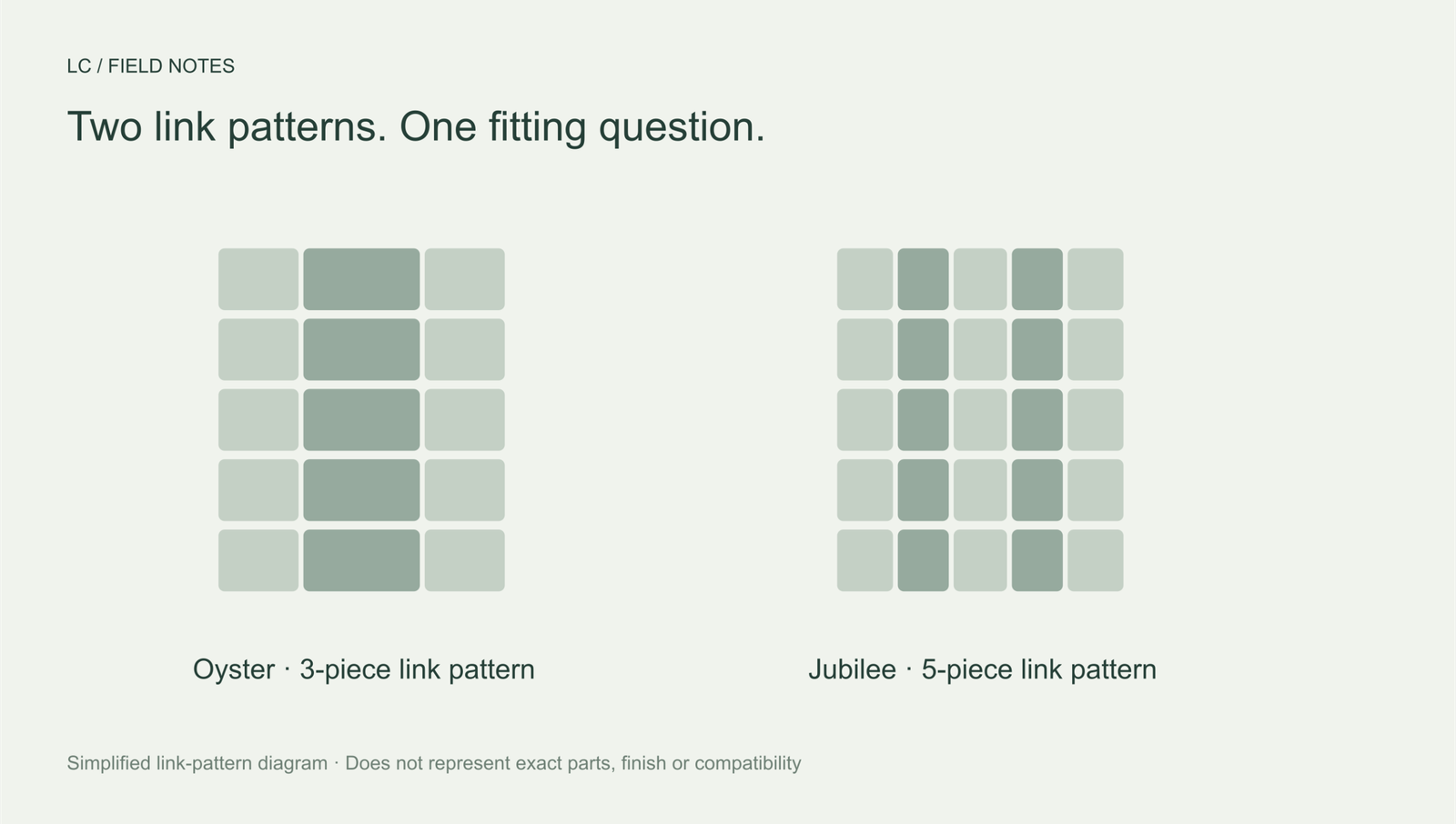
Choose between Oyster and Jubilee by comparing the complete watch, then the fitted bracelet—not by assuming one is always more comfortable. The broader links of an Oyster and the more segmented pattern of a Jubilee give a Datejust different visual rhythms. Your preferred look is only the first part of the decision.
The clasp, adjustment, bracelet condition and fit underneath your wrist deserve as much attention as the dial-side photograph.
The structural difference
Rolex describes the Oyster as a three-piece-link bracelet and the Jubilee as a five-piece-link bracelet. Its Datejust model overview lists both for the original Datejust 36 and 41. It also describes the Oysterclasp and approximately 5mm Easylink extension on the configurations covered by that overview.
These details describe the manufacturer’s watches. Do not assume an older reference, replacement bracelet or separately offered catalog item has identical parts or adjustment.
| Point to compare | Oyster | Jubilee |
|---|---|---|
| Recognisable link pattern | Three-piece links | Five-piece links |
| Editorial visual description | Broader, simpler bands across the wrist | A more finely divided pattern |
| Comfort question | How the actual links and clasp sit when fitted | How the actual links and clasp sit when fitted |
| Adjustment question | Confirm the clasp and available extension | Confirm the clasp and available extension |
| Compatibility question | Match the exact case and bracelet parts | Match the exact case and bracelet parts |
The visual descriptions are styling observations, not measurements of comfort or durability.

Look at the bezel and bracelet together
A bracelet is a large part of what you see when wearing a watch, yet product searches often crop it out. Compare full views rather than dial-only images.
Start with the same case size and similar dial. A fluted bezel with a Jubilee bracelet gives you several repeating details to look at; an Oyster changes that combination. You may prefer either, but the useful question is whether the entire watch has the amount of detail you want.
If you are also comparing two-tone and single-colour versions, separate that choice from the bracelet structure. Otherwise, a preference for one metal colour can be mistaken for a preference for one type of link.
Test the clasp at your desk
During a fitting, turn your wrist over. Notice where the clasp is positioned and whether the bracelet has been adjusted so the watch sits as intended. Ask which links were removed and which spare links will be included.
Rest your arm on a desk, bend your hand and move it through ordinary positions. Check for a distinct pressure point or excessive sliding. If the fit is wrong, ask whether an available adjustment can resolve it before deciding that the bracelet design is the problem.
There is no need to accept a stranger’s comfort ranking. A useful review may suggest something to inspect; it cannot tell you exactly how a different bracelet will feel on your wrist.
Compare the actual finish and condition
Inspect the same parts under similar lighting: outer links, centre links, clasp surfaces and the transition into the case. Ask for clear photographs of the underside and the sides of the bracelet.
Avoid claims such as “this bracelet cannot stretch” or “that one always scratches more.” Those statements can collapse different materials, construction, service histories and wearing habits into one misleading rule.
For a pre-owned item, request a description of its condition and any replacement parts. For another configuration, ask what is actually supplied. A manufacturer’s photograph should not substitute for evidence of the item being offered.
Can you change Oyster to Jubilee later?
Do not build the purchase around an unverified conversion. The reference, generation, end links, spring bars and clasp arrangement all need to be checked. A matching nominal case diameter is not a compatibility guarantee.
Ask for the specific bracelet part or version and confirmation that it fits the exact case. If the answer is uncertain, a qualified watchmaker should assess the combination. Choosing a complete configuration you already want is simpler than assuming a later swap will be easy or inexpensive.
A short enquiry that avoids ambiguity
Use the Datejust collection to identify the two configurations you want to compare, then save them in your selection.
Your request can be brief:
Please confirm the bracelet and clasp supplied with each reference, the sizing range and included spare links. My wrist measures ___ cm. I would like a clear underside photograph and details of any fine adjustment. I am comparing complete watches, not assuming the bracelets are interchangeable.
This gives you a practical answer to assess instead of another general opinion about which bracelet is “best.”
Frequently asked questions
Is Jubilee always more comfortable than Oyster?
No universal result follows from the link pattern. Evaluate the actual bracelet, its condition, clasp and adjustment on your wrist.
Does every Datejust bracelet have Easylink?
Do not apply a current model overview to every generation or replacement part. Verify the clasp and adjustment on the specific watch.
Is Oyster only for casual wear?
No. That is a styling label rather than a restriction. The dial, bezel, metal colour and your clothing all affect the impression.
Can I compare the bracelets without trying them on?
Photographs can help with appearance and visible construction. For fit, also request measurements, sizing options and clasp photographs. Comfort remains something a picture cannot establish.
Editorial note: this guide compares selection criteria and manufacturer-described structures. It does not rate the durability of untested bracelets.