
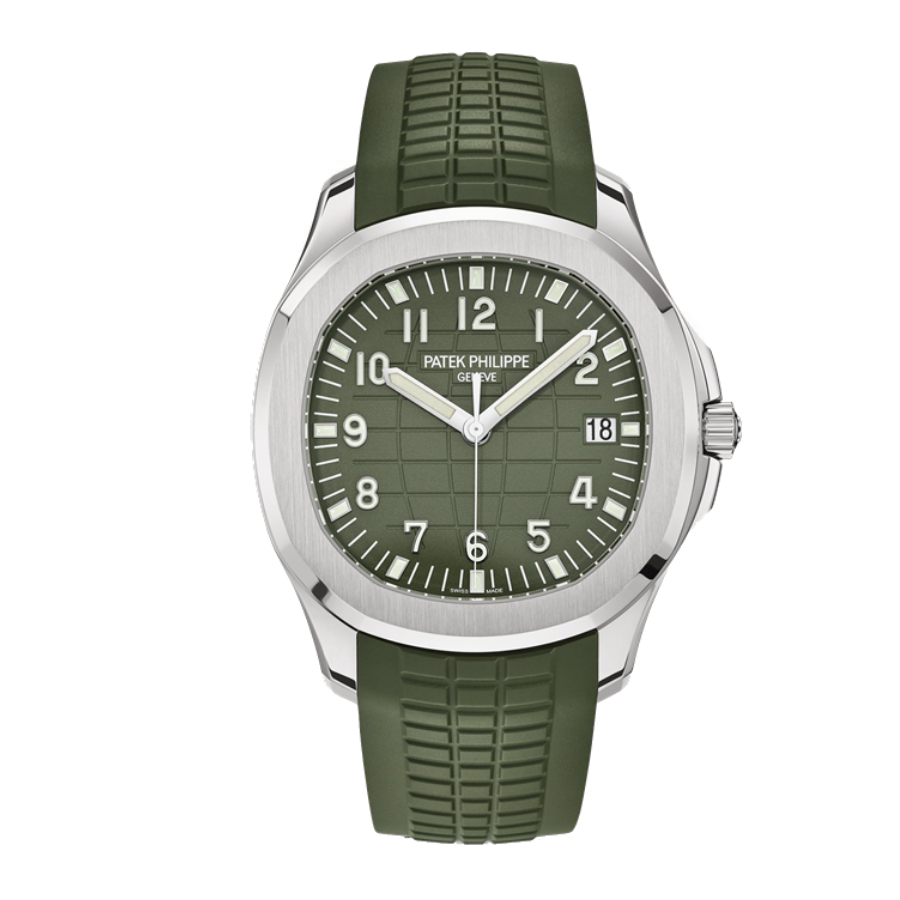
Start with the strap configuration if the flowing dial-and-strap appearance is what attracts you to the Aquanaut. Compare a steel-bracelet configuration if you want more visible metal around the wrist. Make comfort, sizing and compatibility separate checks before choosing.
Buyers often call the strap “rubber,” while Patek Philippe describes the original 5167A-001 as having a composite-material strap. That distinction matters: a familiar search term does not verify the material of an aftermarket strap or another catalog item.
Was there a steel-bracelet Aquanaut?
Yes. Patek Philippe’s 2021 Aquanaut press release documents the steel-bracelet reference 5167/1A-001 alongside strap configurations.
That is historical evidence of a manufacturer configuration. It is not evidence of current stock, the contents of an offer or the compatibility of a bracelet conversion. Keep those questions separate when comparing listings.
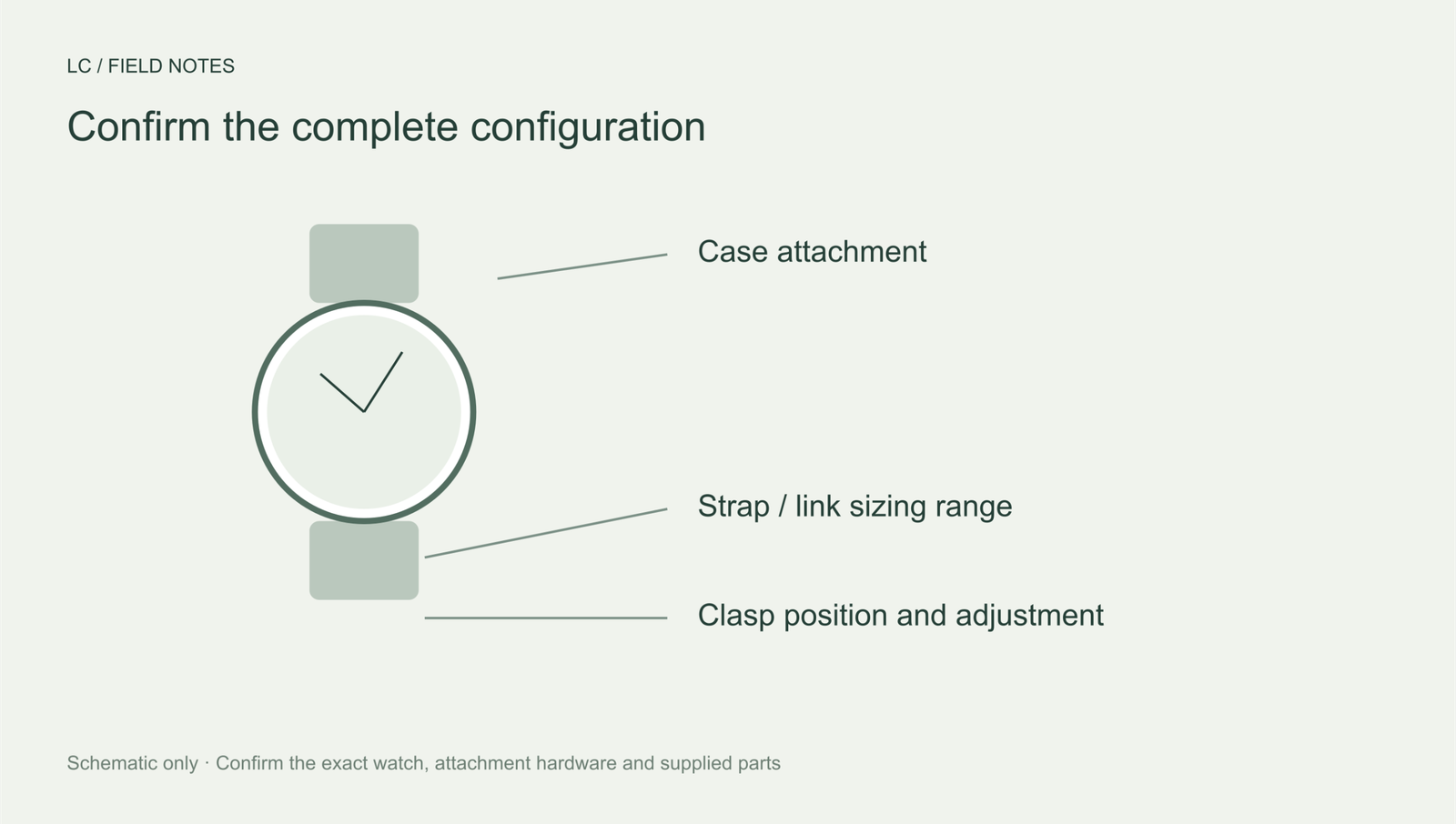
Strap vs bracelet at a glance
| Question | Strap configuration | Steel-bracelet configuration |
|---|---|---|
| What draws your attention? | Colour and pattern continuing beyond the case | Metal links extending the watch’s visual presence |
| What needs fitting? | Strap length, adjustment method and clasp position | Link count, available adjustment and clasp position |
| What should you confirm? | Actual material and replacement options | Actual material, spare links and bracelet version |
| What may complicate a later change? | Case attachment and hardware compatibility | Case attachment, end links and hardware compatibility |
| What does neither option prove? | Water resistance, movement specification or authenticity | Water resistance, movement specification or authenticity |
Compare the full watch, not a detached strap
An isolated bracelet photograph tells you little about the complete result. Request an image of the actual watch with the proposed configuration attached. Look at how the strap or first links meet the case and how the design continues around the wrist.
Keep dial colour and reference consistent where possible. A black strap against one dial and a bracelet against another introduces several changes at once. You may be responding to colour rather than to the strap-versus-bracelet distinction.
Our visual starting point is simple: if the textured strap is central to your interest in the Aquanaut, evaluate that complete configuration first. If the bracelet is the attraction, find a documented complete example instead of treating a conversion as a certainty.
The clasp can determine the fit
Ask where the clasp sits underneath the wrist and how its position can be adjusted. A strap that looks soft in a photograph can still be the wrong length. A bracelet with removable links may still need careful sizing to avoid an awkward clasp position.
Confirm the supported wrist range, links supplied and adjustment procedure. If a strap must be cut, establish the fitting method and replacement cost before any material is removed. Do not assume a cut strap can be restored to its previous length.
Try the watch with your hand relaxed, then bend it as you would during normal use. Check whether the attachment follows your wrist or leaves a stiff projection. This observation is more useful than a blanket claim that every strap is comfortable or every bracelet is heavy.
Treat conversion as a parts question
“Fits an Aquanaut” is too vague. Request the exact watch reference and version, the proposed strap or bracelet, the attachment hardware and evidence of the assembled fit.
A successful conversion on one watch does not establish compatibility across generations or separately manufactured cases. Matching widths also do not settle the shape or position of the attachment points.
Have uncertain compatibility assessed by a qualified watchmaker. Do not force components or assume that modification is a normal part of fitting. If the conversion is essential to your purchase, resolve it before committing rather than leaving it as an afterthought.
Keep material and water-resistance claims separate
A strap that tolerates moisture does not make the watch case suitable for swimming. The relevant evidence concerns the actual case, seals, condition and testing. Neither an Aquanaut-style design nor a manufacturer’s specification for an original reference proves the capability of another item.
Likewise, ask what the supplied strap is made from instead of borrowing the manufacturer’s composite-material description. A precise answer is more useful than “same as original.”
Prepare a configuration-specific enquiry
Browse the Aquanaut collection and keep alternatives in your selection. Send the exact page links, your wrist circumference and whether you want a complete watch or a parts conversion.
Ask for front, side, clasp and attachment photographs. Include questions about sizing, spare links or replacement straps, and the terms that apply after adjustment. Do not assume a bracelet configuration is available simply because an example appears in an old release or online discussion.
Frequently asked questions
Is an original Aquanaut strap ordinary rubber?
Patek Philippe uses the term composite material for the 5167A-001 strap. That description should not be extended to a separately supplied strap without evidence.
Does the steel bracelet fit every 5167-style case?
Do not assume it does. Identify the exact case, bracelet and hardware, then obtain confirmation of their compatibility.
Which configuration is more comfortable?
Comfort depends on the actual fit, adjustment and clasp position. Photographs can help you compare appearance; they cannot reproduce wearing either option.
Should I buy one and plan to change it later?
Only after compatibility, parts availability and the practical cost have been established. Otherwise, start with the complete configuration you prefer.
Editorial note: official reference information is used for context. This is not a hands-on test or a statement of current availability.