
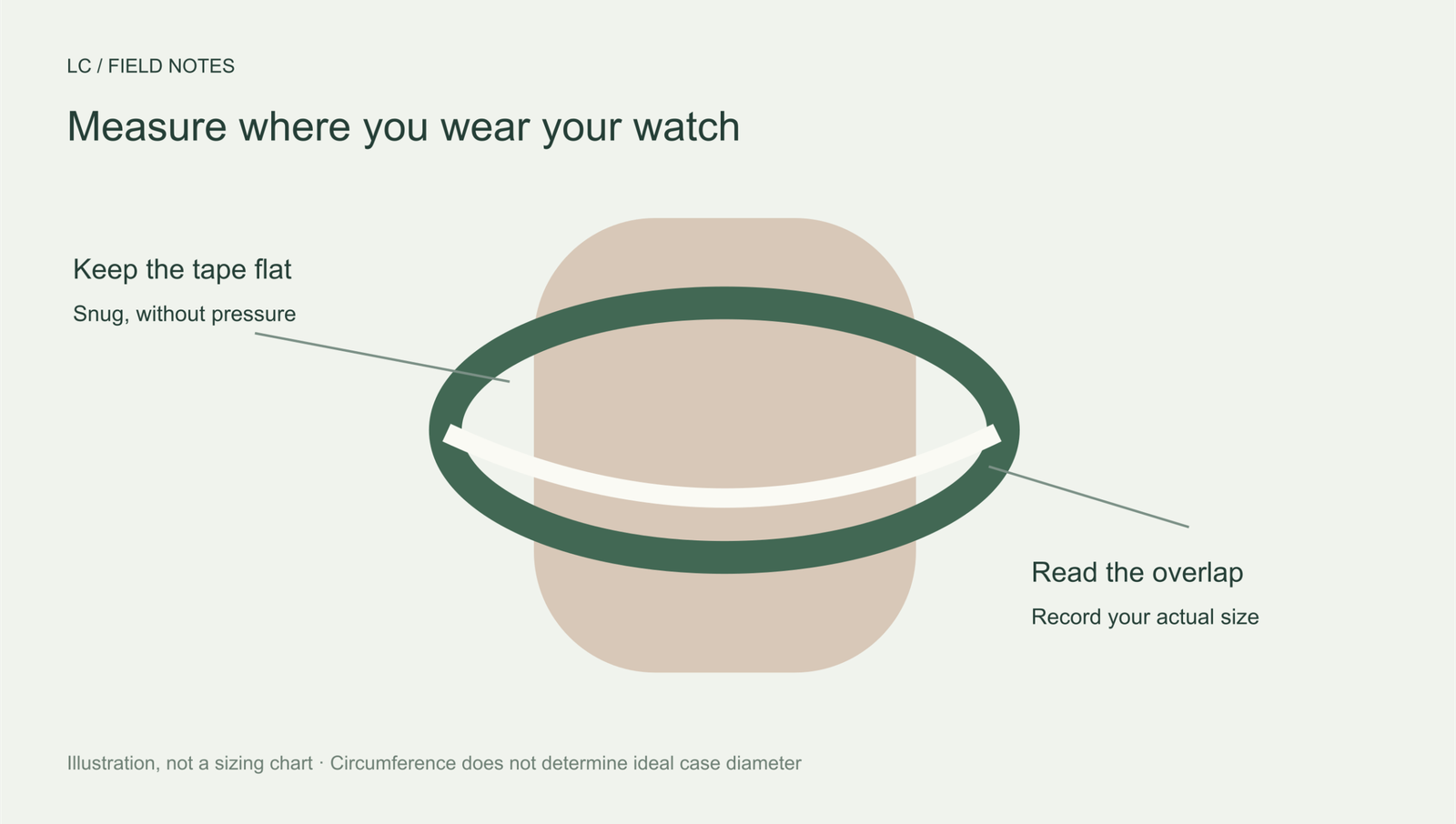
Wrap a flexible measuring tape around the wrist where you normally wear your watch, keep it snug without pressing into the skin, and record the circumference. Repeat the measurement and note whether you prefer a close or relaxed fit. This gives a seller useful sizing information without pretending that one number determines your ideal case diameter.
A wrist measurement is primarily a starting point for the strap or bracelet. To choose the watch itself, you will also need to consider its shape and a watch you already enjoy wearing.
What you need
A soft measuring tape is the simplest option. If you do not have one, use a narrow strip of non-stretch paper, a pen and a ruler. Avoid elastic string or a strip that changes length as you pull it tight.
Work in the units the seller requests. Record the measurement you actually take rather than rounding it to a convenient bracelet size before sharing it.
Measure with a tape
- Put your hand and wrist in a relaxed position.
- Place the tape around the usual watch-wearing position.
- Keep it flat and comfortably in contact with the skin, without digging in.
- Read the measurement where the tape meets its starting point.
- Remove it and repeat, checking that you used the same position and tension.
If your readings differ noticeably, repeat the process rather than averaging measurements taken in different places. The objective is a reproducible circumference, not a reading as tight as possible.
Measure without a tape
Wrap the paper strip around the same position and mark where its end meets the rest of the strip. Lay it flat against a ruler and measure from the starting edge to the mark.
Do not measure an existing strap from end to end and call that your wrist circumference. Strap overlap, the buckle, clasp and the case can all make that a different measurement.
If you use a printable sizing tool, check the print settings. Longines’ official bracelet sizing tool explicitly specifies printing with page scaling set to “None.” Follow the instructions supplied with a particular tool; a reduced printout can give a misleading result.
Inches and centimetres
One inch equals 2.54 centimetres. These examples are rounded to one decimal place and are conversions, not recommended watch sizes:
| Circumference in inches | Approximate circumference in centimetres |
|---|---|
| 6.0 | 15.2 |
| 6.5 | 16.5 |
| 7.0 | 17.8 |
| 7.5 | 19.1 |
| 8.0 | 20.3 |
Keep your original reading as well. If you measured 17.6cm, send 17.6cm rather than replacing it with the nearest row in this table.
Do you need to add extra length?
Do not silently add a fixed allowance and present the result as your actual wrist measurement. Tell the seller your circumference and fit preference separately, then ask how their sizing process accounts for the watch case and clasp.
For example: “My wrist measures 17.6cm at my normal wearing position. I prefer a close fit without pressure. What bracelet adjustment and spare links are included?”
The right adjustment depends on the complete configuration. A cut-to-size strap, a bracelet with removable links and a strap with buckle holes are not sized in exactly the same way. Confirm the procedure before an irreversible adjustment is made.
Why circumference does not choose the case size
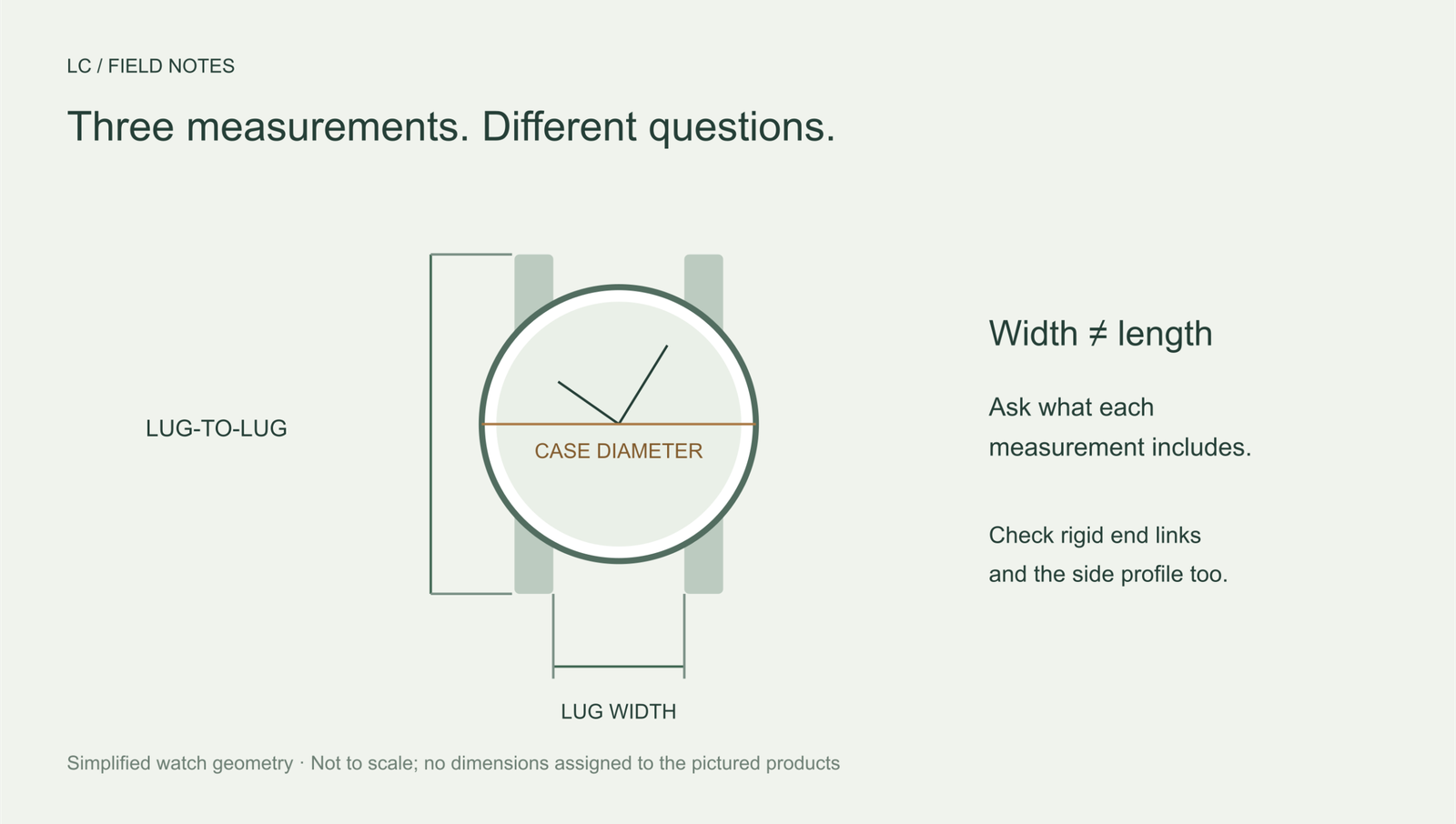
Two wrists with the same circumference can have different shapes across the top. Two watches with the same stated diameter can also have different case lengths and bracelet attachments.
Use a familiar watch as a second reference. Tell the seller its model and what you like or dislike about the fit. Ask for a side view and the actual dimensions of the candidate rather than accepting a chart that assigns one case diameter to every wrist measurement.
The existing Royal Oak 37mm vs 41mm guide shows how to combine measurements with wider and side-view photographs. The process is more useful than judging proportions from one close-up.
What to send with your enquiry
Include your circumference, units, fit preference and a comfortable watch reference. If you need extra links or are choosing a strap configuration, say so early.
Build a shortlist in your selection and ask for the supported sizing range before deciding. A watch that looks right still needs a strap or bracelet that can be adjusted appropriately.
Frequently asked questions
Should the tape be tight?
Keep it snug and flat without compressing the skin. An excessively tight measurement is not a useful description of your ordinary wearing position.
Can I use string?
A non-stretch strip of paper is easier to mark and lay flat consistently. If using string, make sure it does not stretch, and recheck the result with a ruler.
Does a 6.5-inch wrist require a small watch?
No single case size follows from that measurement. Case shape, bracelet fit and your preferred proportions still matter.
Is my current strap length the same as my wrist size?
No. The strap, overlap, fastening and watch case form a complete assembly. Measure the wrist directly and identify the strap or bracelet separately.
Editorial note: the fitting steps are practical guidance. Follow the sizing instructions for the specific bracelet or strap you intend to use.