
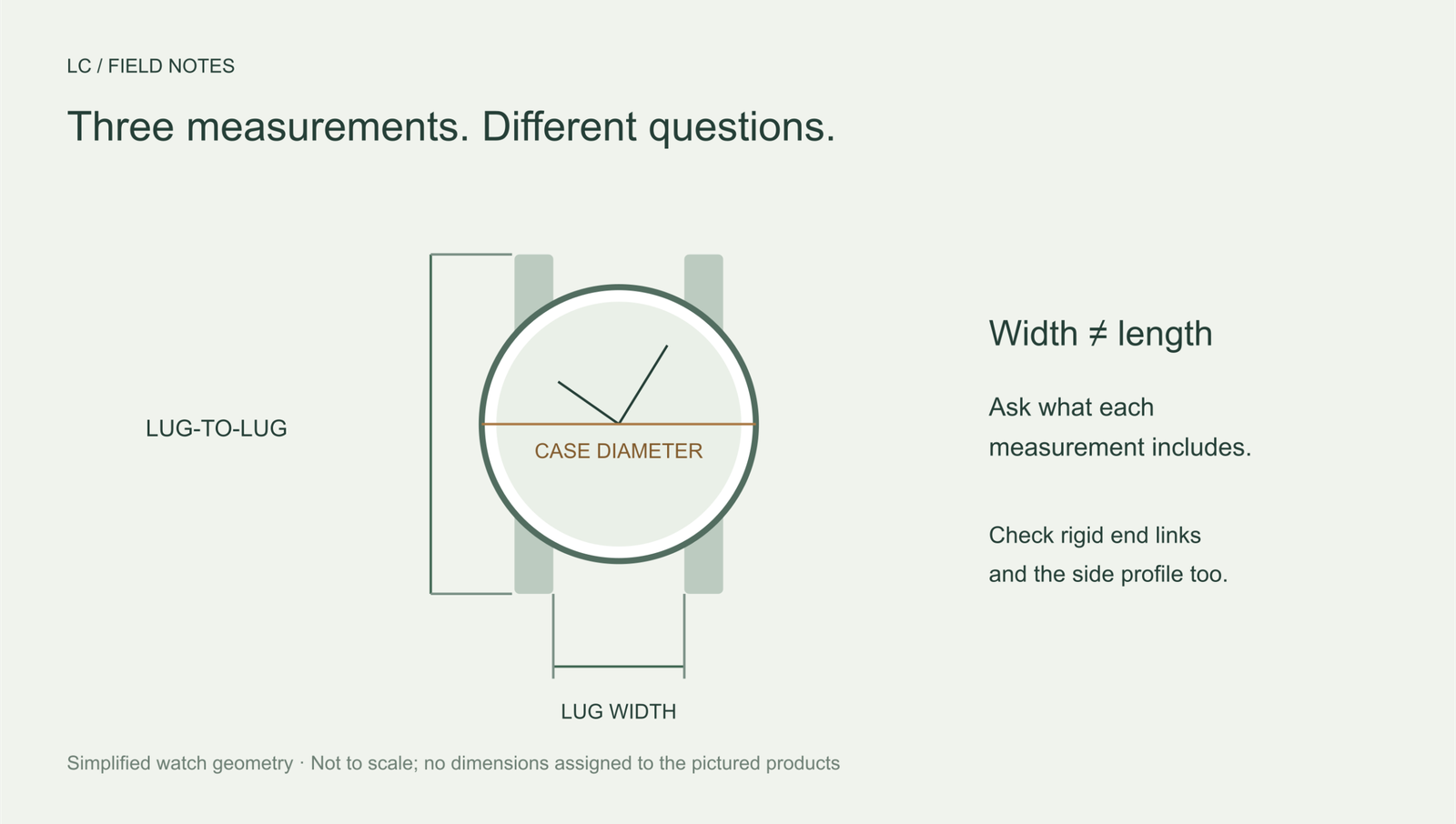
Case diameter describes the width of a round watch case; lug-to-lug describes its length from one end of the lugs to the other. Both help you assess how a watch occupies the wrist. Neither tells the whole story without the case profile and the way the strap or bracelet turns downward.
If two watches have the same advertised diameter but look different on your wrist, you are not imagining the difference. You may be comparing different lengths, dial openings, case shapes or bracelet attachments.
Keep three measurements separate
“Lug width” and “lug-to-lug” are often confused in casual listings. They answer different questions.
| Measurement | What it describes | Why it is useful |
|---|---|---|
| Case diameter | The width of a round case, with the measurement convention confirmed | A starting point for overall scale |
| Lug-to-lug | The length from the outer tip of one lug end to the opposite end | How far the case extends along the wrist |
| Lug width or lug distance | The gap between the lugs where a conventional strap attaches | A starting point for strap sizing, not a guarantee of compatibility |
| Thickness | The height of the case assembly under the stated measuring method | A starting point for checking profile and cuff clearance |
Always ask what the measurement includes. A crown, a projecting case feature or a rigid bracelet end link can change the overall footprint without changing the quoted diameter.
A real specification example
Longines lists the original Flagship L4.984.4.98.6 with a 40mm diameter, 47mm lug-to-lug and 21mm lug distance. The three numbers describe different dimensions of the same watch.
The example shows why “40mm” is incomplete fitting information. It is not a claim that every 40mm watch is 47mm long, or that a 21mm strap automatically fits every attachment of that nominal width.
Use manufacturer dimensions for the reference they describe. For another item, request its own measurements rather than transferring numbers from a similarly named watch.
Why the bracelet can extend the footprint
Look at where the first flexible part of the bracelet begins. If a rigid attachment projects beyond the case before turning downward, the watch may occupy more wrist length than the case-only measurement suggests.
Ask for a side photograph with the bracelet hanging naturally. For an integrated design, request an explanation of how the quoted length was measured. Do not assume that every seller uses “effective lug-to-lug” in the same way.
A measurement annotated on a photograph can help clarify the endpoints. It still needs to show the actual configuration being offered, including the bracelet or strap you intend to wear.
Use wrist shape rather than a rigid formula
Circumference tells you how far a tape travels around your wrist. It does not directly tell you the width or shape of the surface where the watch sits.
During a fitting, look at where the case and attachment end relative to your wrist. Then move your arm and check whether the watch remains centred without uncomfortable pressure. A photograph of another person’s wrist is useful context, not a fitting certificate.
There is no need to turn the comparison into an exact ratio. A case that feels awkward after adjustment should not be rescued by a formula saying it ought to fit. A watch you find comfortable does not become wrong because it falls outside someone else’s preferred proportions.
Dial size and thickness affect the impression too
Two cases with equal external width can devote different amounts of space to the bezel and visible dial. That can change how large the watch appears even when the published case measurement matches.
Thickness adds another consideration. Check whether the watch passes under your normal cuff, and whether the case sits as you expect when viewed from the side. Avoid judging height from a sharply angled promotional photograph.
For a useful comparison, collect a small set of information: diameter, case length, thickness, attachment shape and bracelet fit. You do not need a huge specification sheet; you need consistent measurements of the features that affect your decision.
Ask for a comparison that can be reproduced
Identify a watch you already enjoy wearing and record its reference. Then ask how the candidate differs, using clearly defined measurements.
Please confirm the case diameter, case-only lug-to-lug and thickness. Does the bracelet have a rigid section extending beyond the case? A straight-on photograph with the measurement endpoints and a side view would help me compare the fit.
The Royal Oak fit guide provides a practical example of assessing case proportions and bracelet drop together. When you have two candidates, save them in your selection so the enquiry refers to the exact pages.
Frequently asked questions
Is lug-to-lug more important than diameter?
It answers a different question. Length helps you judge the case footprint, while diameter helps describe width. Assess both alongside the attachment and profile.
Is lug width the same as lug-to-lug?
No. Lug width is the space between the lugs for a conventional strap attachment. Lug-to-lug runs from one outer end of the case’s lugs to the other.
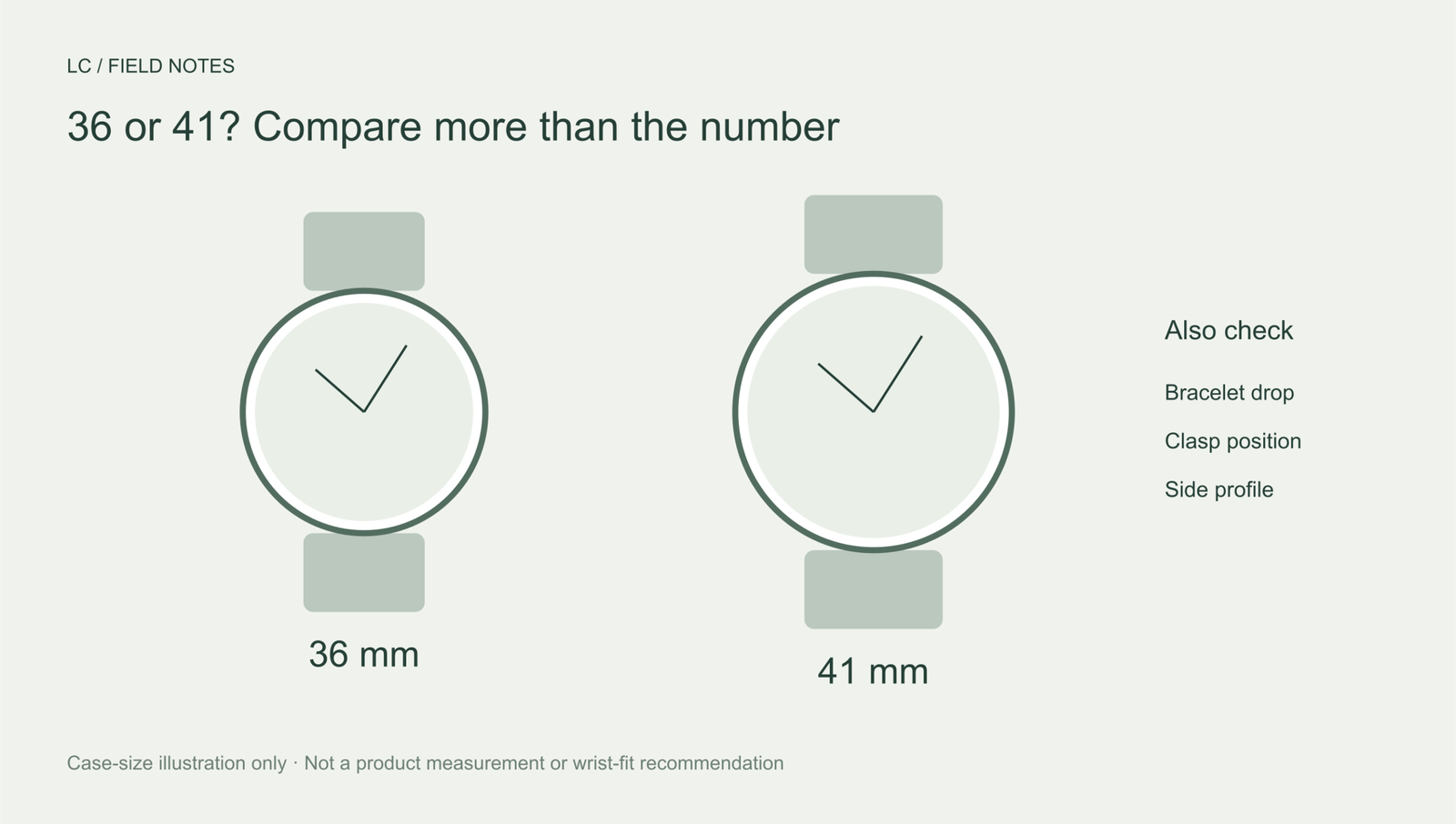
Can two 41mm watches fit differently?
Yes. Their lengths, case shapes, thicknesses and bracelets may differ. Compare specific references rather than expecting the diameter to describe the whole fit.
Can I estimate the dimensions from a photograph?
Do not rely on an unscaled image for an exact measurement. Request documented dimensions and clear measurement endpoints; use the photograph to understand shape and proportions.
Editorial note: the Longines example explains terminology. It does not establish the measurements or fit of other catalog products.