
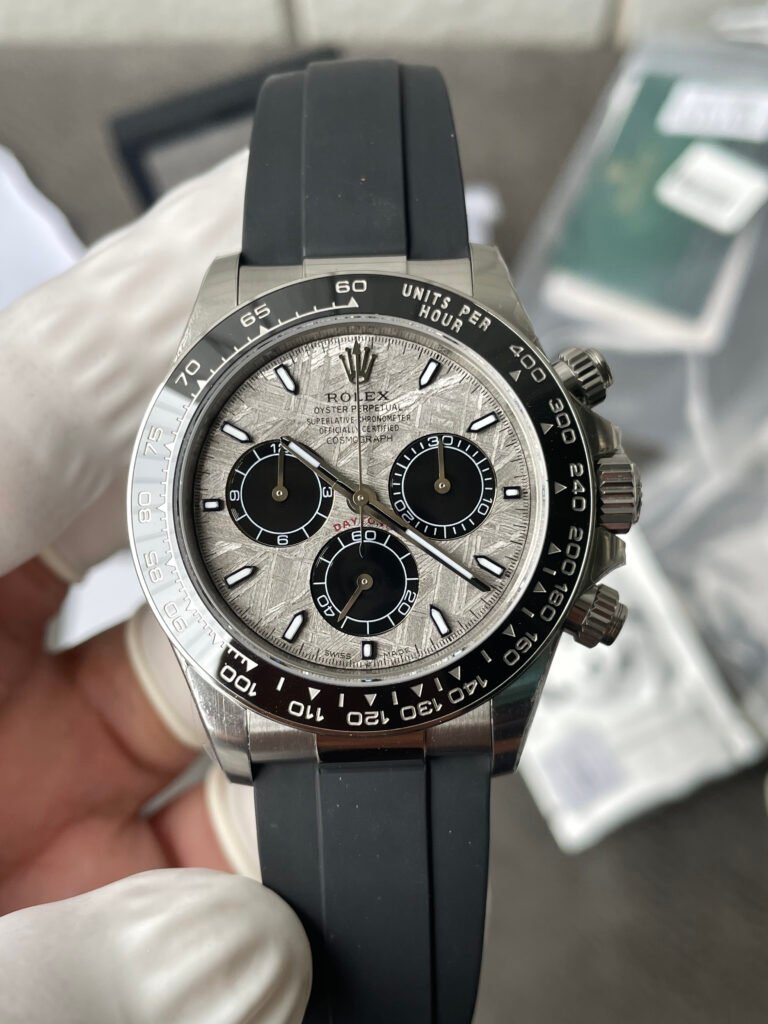
The contrast catches the eye before the texture does: three black circles sit against a silver-grey dial, enclosed by a black outer ring and continued by a black strap. Look closer, and the dial breaks into intersecting lines and angular patches. That shift between a clear silhouette and a busy surface gives this photographed configuration its character.
These six views let us follow that relationship around the watch. Start with the front photograph above, then use the other angles to separate dial detail, case shape and the strap’s connection to the clasp.
Pattern and contrast in the front and angled views
In the front view, the pattern occupies the spaces between the three subdials. Their dark centres interrupt the fine lines, while narrow pale rings and small markings give each circle a defined edge. Pale hour markers repeat around the outside. The small red Daytona lettering above the lower subdial adds a restrained colour accent to an otherwise largely monochrome face.
The black bezel creates another boundary. Its large pale numerals are visually separate from the finer markings inside, so the face reads in layers: outer scale, textured ground, then the three dark circles.

Compare the front and angled photographs using the lower subdial and nearby hour markers as landmarks. Follow a patch of texture beside them rather than comparing the overall brightness of the two images. In the angled view, the case rim and hands catch light differently; those reflections change which edges stand out. This is a comparison of views within one source set, not two versions of the watch.
How the case outline frames the dial
Turn to the side profile and the dial pattern drops out of sight. The outline becomes the subject: a curved silver-coloured case flank, the edge of the dark bezel and the black strap bending away from each end. The reflection across the flank follows a different path from the clean outer silhouette. Trace the silhouette first, then look at the reflections within it.

The opposite side adds three projecting forms. A central crown sits between two pushers, with ridged collars and rounded end surfaces creating smaller changes of light and shadow. This view explains why the two sides have different silhouettes even though the dial is unchanged.

Neither angle contains a measurement scale. For interpreting how case length differs from width, our case diameter and lug-to-lug guide explains the distinction without assigning dimensions to these photographs.
The black strap and open clasp
From the front, the strap repeats the darkness of the bezel and subdials. Its long, relatively plain surfaces give the eye a pause after the dial’s intersecting pattern. The raised central strip introduces a simple lengthwise line rather than another cluster of small details.
The open-clasp photograph changes the composition. Bright folding sections extend diagonally across the frame, revealing an articulated structure that the front view largely hides. Follow the hinges from one side to the other to understand how the photographed pieces connect. The useful observation here is their arrangement, not the decorative markings on their surfaces.

Completing the view from the back
The back provides a quieter finish to the sequence: a broad circular centre with fine linear texture, a notched border and the shaped undersides of the black strap. Compare this relatively uninterrupted surface with the many overlapping forms on the dial side. Together, the views show where the visual complexity is concentrated.

For assessing an individual item beyond its appearance, the separate QC photo guide explains what photographs can and cannot establish.
Source note: these are supplier photographs, not LC photography or hands-on testing. The source describes “VS4131,” “RB meteorite dial” and “high-transparency glass”; those remain unverified source statements. “Meteorite-pattern” describes the visible appearance. The complete reference, material composition, brand authenticity and actual movement are not established here.
Which detail draws you in: the patterned spaces, the repeated black shapes or the side profile? Ask About This Look with the photo number and detail you mean. Any pricing discussion is private.