

Try the Datejust 36 first if you prefer a compact watch with more visible space around the case. Try the 41 first if a broader dial and stronger wrist presence are part of the appeal. Neither choice follows automatically from your wrist circumference.
The most useful comparison is the same style in both sizes. Changing the dial colour, bezel and bracelet at the same time makes it difficult to tell whether you prefer the size or simply prefer one configuration.
What the size numbers actually tell you
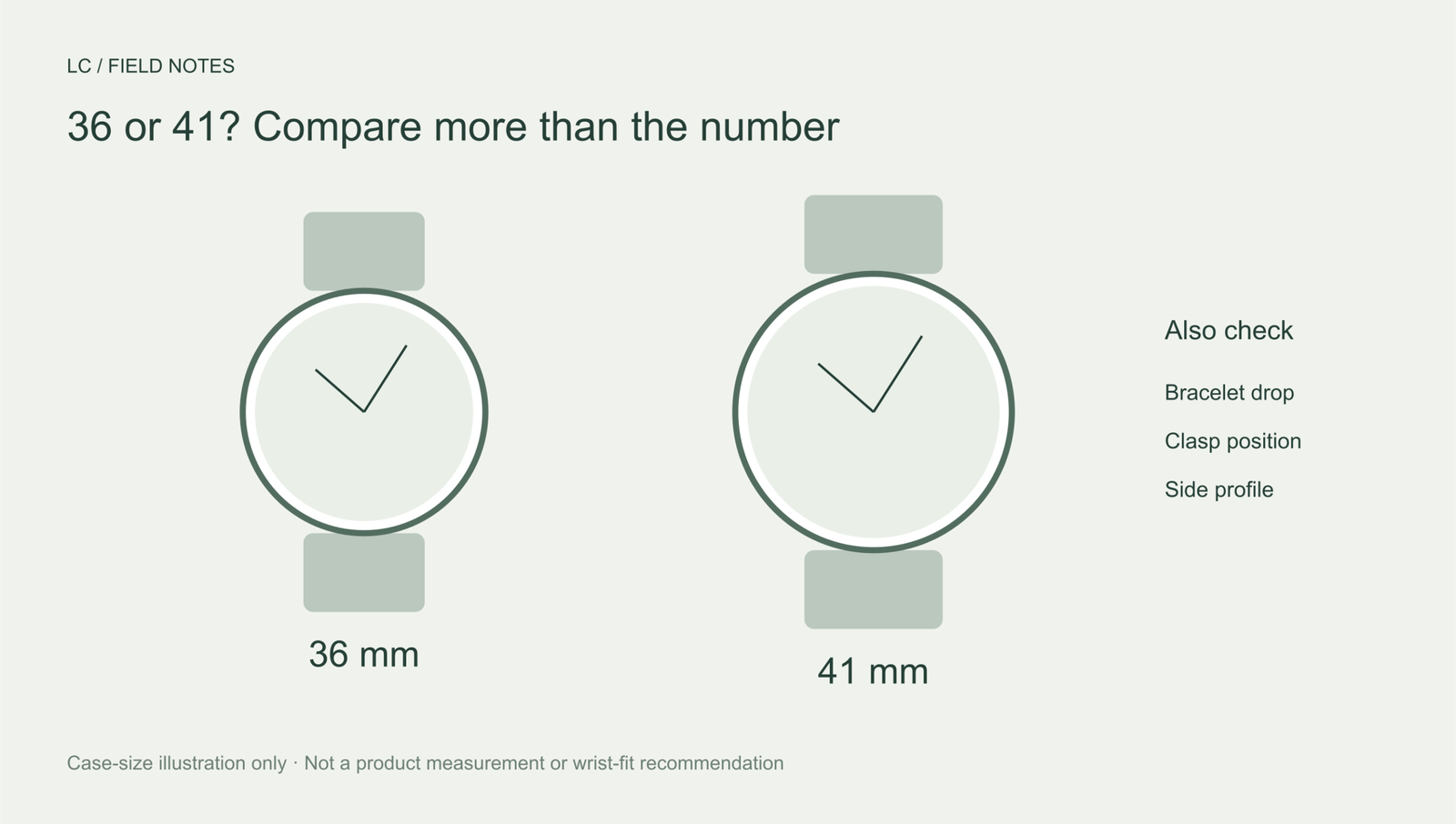
Rolex identifies the original Datejust reference 126203 as 36mm and reference 126300 as 41mm. Those are manufacturer case-diameter specifications for the references shown.
The numbers do not describe the complete length across your wrist, the way the bracelet turns downward or the position of the clasp. They also do not verify the measurements of a separate catalog item. Ask for that item’s own dimensions if the distinction matters to your decision.
| Question | Start by trying 36mm | Start by trying 41mm |
|---|---|---|
| How much presence do you want? | A compact outline | A broader outline |
| What do you already wear? | Smaller watches get most of your wrist time | You consistently prefer larger cases |
| What should the comparison test? | Whether the dial feels large enough for you | Whether the case and bracelet feel comfortable in motion |
| What remains individual? | Bracelet fit, wrist shape and visual preference | Bracelet fit, wrist shape and visual preference |
This table gives you an order for trying the watches. It is not a size prescription.
Use a comfortable watch as your baseline
Bring or identify a watch you enjoy wearing for several hours. Write down its reference and what works: perhaps the case stays centred, the clasp avoids a pressure point or the dial is easy to glance at.
Then name the change you want. “I like this fit but want a more visible dial” is more useful than “I have a medium wrist.” Conversely, “I want less case overhang” identifies a problem that a diameter label alone cannot resolve.
Do not compare an adjusted bracelet on one candidate with an oversized display bracelet on the other. Ask for a fitting first. Excess movement can make a watch seem less comfortable without telling you much about the case itself.
Keep the bezel and dial reasonably consistent
A dial and bezel affect how you read the watch’s proportions. For an initial comparison, use similar colours and the same bracelet style where possible. Look from a normal viewing distance before studying close-up photographs.
Then explore a different finish if you want one. Separating these decisions helps: choose the scale you prefer, then assess whether the particular dial or bezel changes your impression.
Avoid simple rules such as “a fluted bezel always makes the watch look bigger.” Your own comparison is more useful than turning a visual tendency into a guaranteed result.
Check five things during a fitting
- Top view: is the case centred, and do you like the space around it?
- Side view: where does the bracelet start bending around your wrist?
- Underside: does the clasp sit comfortably, or does an edge create pressure?
- Movement: bend your hand and rest your arm on a table as you normally would.
- Clothing: test a shirt or jacket cuff you actually wear.
Spend time with your arm relaxed rather than holding a fixed photograph pose. A watch that looks balanced for one shot may still feel awkward during routine movement.
If possible, compare both sizes in one session. A memory of a fitting several weeks earlier is a weak substitute for seeing and wearing the alternatives together.
Buying remotely: ask for comparable evidence
Request a straight-on view, a side profile and a wider wrist photograph. Similar camera distance and framing make the images easier to compare. Tell the seller your wrist circumference and whether you prefer a snug or relaxed fit.
Ask for the case width and thickness, bracelet sizing range and number of links supplied. Also ask whether any size adjustment affects the applicable return terms. Do not assume you can buy either size and exchange it after altering the bracelet.
For more on evaluating wrist photographs, the Royal Oak size guide explains a similar comparison process. Its fitting method can be useful; its model-specific dimensions should not be transferred to a Datejust.
Choose a pair, not an endless gallery
Shortlist two examples in the Datejust collection and add them to your selection. Explain the difference you want to evaluate instead of asking for a universal “best size.”
If both are comfortable, you are allowed to choose on appearance. A larger wrist does not require the larger watch, and a smaller wrist does not remove the larger watch from consideration without a fitting.
Frequently asked questions
Is the Datejust 36 too small for a larger wrist?
Not automatically. A compact watch can be a deliberate style choice. Look at the proportions you enjoy and make sure the bracelet can be fitted appropriately.
Is 41mm always more readable?
A larger case label alone does not settle readability. Compare the actual dial, markers, contrast and date display in ordinary lighting.
Can I choose from my wrist circumference alone?
No. Circumference helps with bracelet sizing but does not fully describe wrist shape, preferred appearance or clasp comfort. Use it alongside a familiar watch and comparable photographs.
Should I trust close-up wrist photos?
Use them for detail, not as the only evidence of proportions. Add side and wider views, and remember that another person’s wrist and bracelet adjustment may differ from yours.
Editorial note: the fitting process is editorial guidance. It is not a claim of personal wear testing.